Our Blog
WEBSITE DEVELOPMENT IN INDIA
In the decade website development in India has changed a lot. It is not about getting a website made from someone else. Now it is an industry that is always coming up with new things. If you have a business in Meerut and you want to have a website or if you are someone who works on your own and you want to learn new skills or if you are starting a new company then you will see that website development in India is full of good things and also some problems. In this post we will talk about what’s happening now what problems people are facing and some tips to make a good website that people will like and that will help your business. Why is website development important in India? A website is not something that you look at on the internet. It is the thing that people see when they want to know about your company. With more people using the internet and smartphones in cities and towns in India people want websites that are fast and work well on their phones. For businesses a good website helps people trust you and find you. For companies a website is often the first thing that people see and it helps them to know if their idea is good or not. There are some things that’re popular now in website development. Making websites that work well on phones is very important. Most people in India use their phones to look at websites. So websites need to be made in a way that they work well on phones. Some websites are like phone apps. You do not need to install them. This is good because it saves space on your phone and does not use much internet. Some websites are made in a way that the front and back parts are separate. This makes the website fast. It can handle a lot of people at the same time. There are some tools that make it easy to make a website without knowing how to code. Making websites that can be used by people who speak different languages is also important. If you want to make a website you need to think about some things. You need to make sure that your website is safe and secure. You need to see how people are using your website and make changes to make it better. If you want to hire someone to make your website you need to look for some things. You need to see the work they have done before and what they have achieved. You need to make sure that they will talk to you regularly and tell you what they are doing. You need to know what will happen after they make your website. Will they help you if you need it? You need to make sure that they know about the market and how things work here. The cost of making a website can vary a lot. A simple website can cost between ₹10,000 and ₹50,000. A website for a business can cost between ₹50,000 and ₹2,00,000. A big website with advanced features can cost more than ₹2,00,000. The important thing is to have a clear idea of what you want, make a website that people will like and keep making it better. Whether you make your website with someone who works on their own, a company or a tool that makes it easy to make websites, you need to make sure that it is fast, works well on phones and is suitable for the Indian market. These things will help you to get customers.
WHY DO STARTUPS NEED PROFESSIONAL WEBSITES
The development of a professional website is one of the best things that a startup company can invest in. Not just a virtual business card, the website enhances credibility, supports marketing, and helps grow your business. Even when budgets are limited, a professional website is an essential investment. First impressions matter. A well-designed website demonstrates professionalism and builds trust with customers, investors, and partners. It also allows startups to tell their story, introduce their team, and explain their products or services in a compelling way. A professional website increases visibility. Search engine optimization (SEO) helps potential customers discover your business online, reducing customer acquisition costs. Unlike social media platforms, your website is an asset you fully own and control. Your website can reach both local and international audiences. With the right design and optimization, startups can attract customers from different markets and expand their business opportunities. Professional websites also improve lead generation and conversions. Dedicated landing pages, contact forms, downloadable resources, and newsletter subscriptions help convert visitors into potential customers. Consistent branding is another major advantage. Your website reflects your brand identity through colors, messaging, visuals, and user experience. Blogs, FAQs, and resource sections educate visitors and build confidence in your business, while product demonstrations, screenshots, and videos showcase your offerings effectively. A website also supports sales and partnerships. Sales teams can share pricing, documentation, and case studies directly from the website. Potential partners and investors often evaluate startups online, making a professional website an important credibility factor. Documentation and knowledge bases also simplify customer onboarding. From a marketing perspective, a website is a long-term investment. While paid advertising stops generating results once the budget ends, SEO, content marketing, and brand building continue delivering value over time. Websites also serve as the destination for social media campaigns, advertisements, and PR activities. Analytics provide valuable insights into customer behavior. By tracking visitor interactions, performing A/B testing, and collecting customer feedback, startups can continuously improve their products, marketing strategies, and website performance. Professional websites also help attract talented employees and investors. Job seekers often research companies before applying, and investors expect a professional online presence when evaluating startups. When building a startup website, define clear objectives such as lead generation, showcasing products, or selling online. Prioritize fast loading speeds, mobile responsiveness, clear headlines, compelling calls to action, and easy navigation. Publish high-quality blogs and resources regularly to improve search rankings and establish authority. Startups can reduce initial costs by using templates or website builders while investing in professional design for critical pages. Integrating analytics tools like Google Analytics and a CRM system helps monitor performance and manage leads effectively. Finally, budget for ongoing hosting, maintenance, and content updates to keep the website secure, reliable, and relevant.
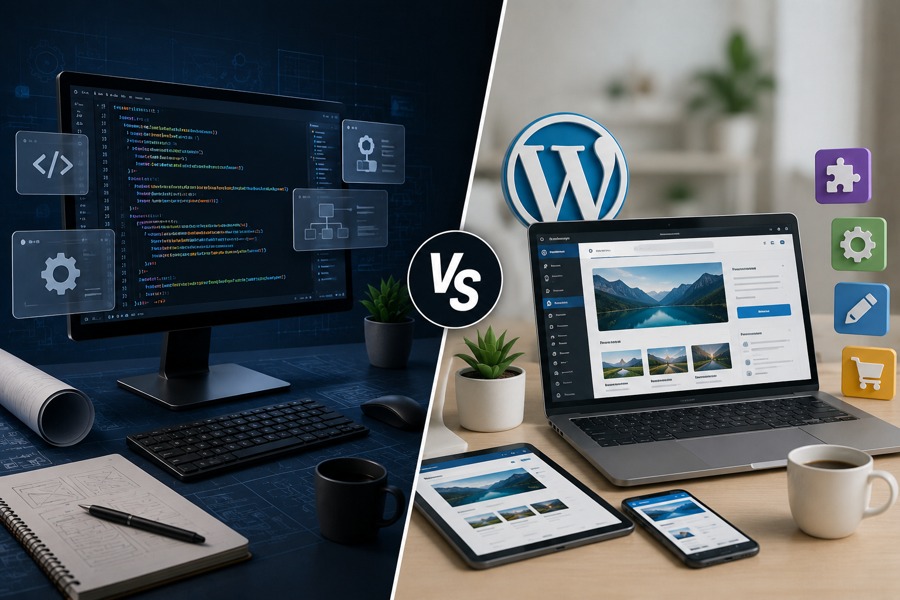
CUSTOM WEBSITE VS WORDPRESS
These days every business needs a website. A website is like a window to a company. It helps people learn about the company, its products, and its services. When creating a website, many businesses wonder whether they should build a custom website or use WordPress. Both options are popular, but they differ in cost, development time, flexibility, performance, and maintenance. The right choice depends on your business goals, budget, and future plans. A custom website is built from scratch by developers according to specific business requirements. Every design element, feature, and functionality can be tailored to meet unique needs using programming languages and modern frameworks. WordPress is one of the world's most popular website-building platforms. It allows users to create websites using ready-made themes and plugins without requiring extensive coding knowledge. It is widely used for blogs, business websites, and online stores because of its ease of use. One of the biggest differences is development time. WordPress websites can often be completed within a few days or weeks because themes and plugins are readily available. Custom websites take longer because every component must be designed, developed, tested, and optimized from scratch. Cost is another major factor. WordPress is generally more affordable, making it a preferred choice for startups and small businesses. Custom websites require more development time and technical expertise, resulting in higher costs depending on the project's complexity. When it comes to flexibility, WordPress offers thousands of plugins and themes that make it easy to add features such as contact forms, blogs, galleries, and e-commerce. However, highly customized functionality can be difficult to implement. Custom websites provide complete flexibility, allowing businesses to create unique designs and advanced features tailored to their exact requirements. Performance depends on how the website is built and maintained. WordPress websites can perform well when properly optimized, but installing too many plugins may reduce speed. Custom websites usually include only the required features, making them faster and more suitable for high-traffic or large-scale applications. Security is another important consideration. Since WordPress powers millions of websites worldwide, it is frequently targeted by hackers. Regular updates to themes, plugins, and the WordPress core are essential. Custom websites are generally less exposed to common attacks, but they still require proper security practices and ongoing maintenance. WordPress provides an easy-to-use content management system (CMS), allowing website owners to update pages, upload images, and publish blog posts without technical knowledge. Custom websites may require developers to build a dedicated admin panel or integrate a CMS, which increases development time and cost. Search Engine Optimization (SEO) is possible with both options. WordPress offers beginner-friendly SEO plugins that simplify optimization. Custom websites can also achieve excellent SEO performance through clean coding, optimized structure, and technical improvements, although they usually require more developer involvement. Maintenance differs between the two approaches. WordPress websites need regular updates for plugins, themes, and the core software, and occasional compatibility issues may arise. Custom websites also require maintenance, but developers have full control over updates and code changes. Many businesses rely on third-party services such as payment gateways, email marketing platforms, and customer relationship management (CRM) systems. WordPress makes these integrations simple through ready-made plugins, while custom websites allow developers to build tailored integrations for more advanced business requirements. WordPress is the right choice when you have a limited budget, need to launch quickly, want to manage content yourself, or require a website primarily for information, blogging, or a small business. It provides an affordable and practical solution for many organizations. A custom website is a better choice when your business requires unique functionality, custom designs, high performance, advanced security, or the ability to scale as your business grows. Large organizations and businesses with complex workflows often benefit more from custom development. Some businesses choose a hybrid approach by using WordPress as the content management system while developing a custom front end for improved performance, flexibility, and user experience. This combines the advantages of both platforms. Before making a decision, businesses should evaluate their budget, project timeline, required features, future scalability, technical support, and long-term maintenance needs. Considering these factors helps ensure the right solution is selected. Both WordPress and custom websites have their own strengths. WordPress offers affordability, speed, and ease of use, while custom websites provide greater flexibility, performance, and complete control. The best choice depends on your business objectives, budget, and long-term growth plans.
MOBILE APP DEVELOPMENT COST: WHAT STARTUPS SHOULD KNOW
Mobile applications have become an essential part of everyday life. People use apps for shopping, learning, banking, entertainment, food delivery, and much more. As a result, many startups want to build their own mobile applications. However, developing an app requires careful planning, time, and investment. The total development cost depends on the type of application, its features, and the technologies involved. Understanding these factors helps startups plan their budgets more effectively. Several factors influence the cost of mobile app development. The most important is the features and functionality of the application. A simple app with basic information is much less expensive than an app that includes user authentication, payment gateways, live chat, push notifications, GPS tracking, or other advanced features. Another major factor is platform selection. Mobile applications are generally developed for Android, iOS, or both. Building separate native applications for both platforms usually increases development costs, while cross-platform development can reduce both time and expenses. Design also plays a significant role in the budget. Basic user interfaces are more affordable, whereas custom designs with animations, interactive elements, and premium user experiences require additional design and development effort. A well-designed application improves user satisfaction and engagement. Backend infrastructure is another important cost component. Most applications require databases, cloud storage, APIs, and servers to manage user data and application functionality. These services increase the overall development budget. The choice of development team also affects pricing. Freelancers are generally more affordable, while experienced agencies and software development companies charge higher fees because they provide end-to-end services including planning, design, development, testing, deployment, and ongoing support. Mobile application development typically follows several stages. The process begins with planning, where the business goals, target audience, and required features are identified. This is followed by UI/UX design, where the application's layout, navigation, and visual appearance are created. The development phase comes next, during which developers write the code and build the application's functionality. After development, the application undergoes testing to identify and fix bugs, improve security, and ensure smooth performance across devices. Finally, the application is published on platforms such as the Google Play Store and Apple App Store, followed by continuous maintenance, updates, and security improvements. The development cost depends largely on the project's complexity. Simple mobile applications generally cost between ₹3 lakh and ₹8 lakh. Medium-complexity applications with features such as user login, payment integration, and basic dashboards typically cost between ₹8 lakh and ₹25 lakh. Advanced applications that include real-time communication, GPS tracking, AI features, or multiple third-party integrations often cost more than ₹25 lakh. Startups can reduce development costs by building a Minimum Viable Product (MVP). An MVP includes only the essential features required to validate the business idea before investing in a full-scale product. This approach reduces initial investment and helps gather valuable user feedback. Prioritizing essential features instead of adding unnecessary functionality also helps control costs. Using existing third-party services for payments, authentication, analytics, and notifications is usually more cost-effective than developing these systems from scratch. Cross-platform development frameworks allow developers to build Android and iOS applications using a single codebase, reducing both development time and overall expenses. Startups can also launch a basic version of their application first and introduce additional features gradually based on customer feedback. Apart from development expenses, startups should also consider hidden costs such as app store registration fees, cloud hosting, server maintenance, security updates, software licensing, marketing, advertising, and legal or privacy compliance. Planning for these expenses prevents unexpected financial challenges after launch. The time required to develop a mobile application depends on its complexity. A simple application generally takes around 2 to 3 months. Medium-complexity applications usually require 3 to 6 months, while advanced applications with sophisticated features may take 6 to 12 months or even longer. Mobile application development is a long-term investment for startups. The final cost depends on factors such as features, design, platform selection, technology stack, backend infrastructure, and the development team. By carefully planning the project, building an MVP, focusing on essential features, leveraging existing services, and accounting for hidden costs, startups can create successful mobile applications while keeping development expenses under control.
DIGITAL TRANSFORMATION: A SIMPLE GUIDE
Digital transformation is the process of using technology to improve how a business or organization operates. Today, organizations use computers, smartphones, websites, software, and digital tools to complete tasks more efficiently. These technologies help employees work faster, improve communication, and provide better services to customers. Digital transformation is not just about adopting new technology—it is about improving processes, decision-making, and overall business performance. A successful digital transformation begins with setting clear goals. Organizations should identify what they want to achieve, such as improving customer service, increasing productivity, reducing costs, saving time, or expanding the business. Clear objectives help teams stay focused and measure their progress effectively. Before implementing new technology, businesses should understand their current operations. This includes reviewing existing processes, evaluating current software and tools, and identifying areas that need improvement. For example, organizations that rely heavily on paperwork can automate repetitive tasks to improve efficiency. Customer experience should always remain a priority. Digital transformation should make it easier for customers to interact with a business through user-friendly websites, responsive mobile applications, faster customer support, and convenient online services. A better customer experience builds trust and encourages long-term relationships. Organizations should avoid making too many changes at once. Starting with small projects allows businesses to test new ideas, learn from results, and gradually implement larger improvements. This approach reduces risks and makes the transformation process more manageable. Choosing the right technology is essential. Businesses should invest in tools that are easy to use, reliable, cost-effective, and suitable for their specific requirements. Technologies such as cloud storage make it easier for teams to collaborate and access information securely from different locations. Data plays a vital role in digital transformation. Businesses can use data to understand customer behavior, improve products and services, make informed decisions, and monitor overall performance. For example, e-commerce companies can analyze purchasing patterns to identify popular products and improve marketing strategies. Employee training is equally important. Technology delivers value only when employees know how to use it effectively. Organizations should provide continuous training to help staff develop digital skills, adapt to new systems, and work confidently with modern technologies. Businesses should also improve existing workflows before introducing new technology. Simplifying processes, removing unnecessary steps, and creating efficient workflows allow digital tools to deliver better results and increase productivity. As businesses become more digital, protecting information becomes increasingly important. Organizations should implement strong passwords, protect customer data, maintain regular backups, and deploy effective cybersecurity measures. Strong security practices help prevent cyberattacks and maintain customer trust. Digital transformation is an ongoing process that requires continuous monitoring. Organizations should regularly measure key performance indicators such as customer satisfaction, sales growth, cost savings, and employee productivity. Monitoring these metrics helps identify successful strategies and areas that need improvement. People are just as important as technology. Organizations should invest in employee development, encourage innovation, and hire skilled professionals when necessary. A knowledgeable workforce enables businesses to adapt quickly to technological changes and achieve long-term success. Careful budget management is another key factor. Businesses should spend wisely, avoid unnecessary purchases, monitor project expenses, and allocate funds for unexpected costs. Proper financial planning helps ensure digital transformation projects remain sustainable and successful. Organizations should also avoid common mistakes such as focusing only on technology, introducing too many changes at once, failing to train employees, ignoring customer needs, or neglecting cybersecurity. Addressing these challenges significantly improves the chances of a successful transformation. Digital transformation is no longer optional for modern businesses. Organizations that embrace technology, improve their processes, invest in their people, and continuously adapt to changing customer expectations are better positioned for long-term growth and success. By implementing digital transformation strategically, businesses can become more efficient, competitive, and prepared for the future.