2026-07-25
custom website vs wordpress
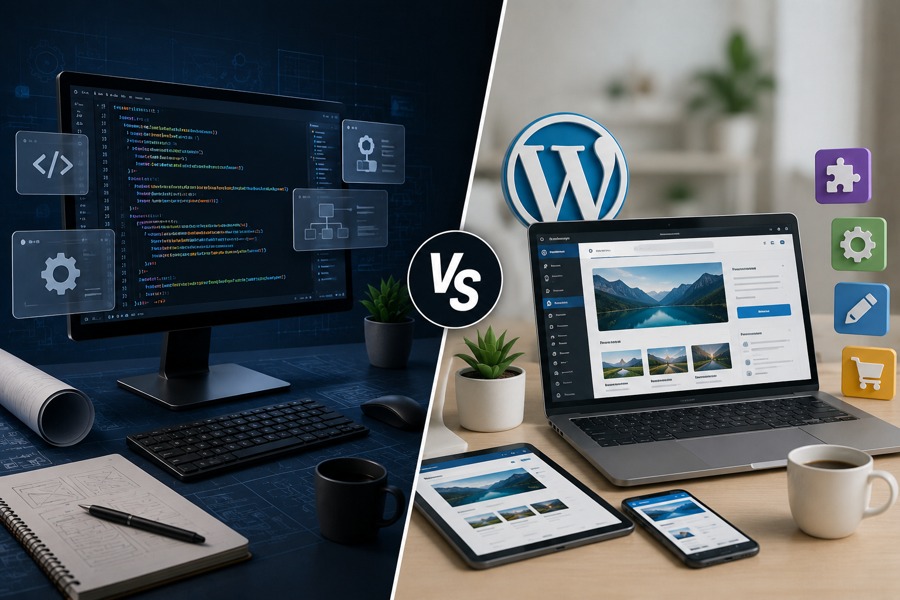
These days every business needs a website. A website is like a window to a company. It helps people learn about the company, its products, and its services. When creating a website, many businesses wonder whether they should build a custom website or use WordPress. Both options are popular, but they differ in cost, development time, flexibility, performance, and maintenance. The right choice depends on your business goals, budget, and future plans.
A custom website is built from scratch by developers according to specific business requirements. Every design element, feature, and functionality can be tailored to meet unique needs using programming languages and modern frameworks.
WordPress is one of the world's most popular website-building platforms. It allows users to create websites using ready-made themes and plugins without requiring extensive coding knowledge. It is widely used for blogs, business websites, and online stores because of its ease of use.
One of the biggest differences is development time. WordPress websites can often be completed within a few days or weeks because themes and plugins are readily available. Custom websites take longer because every component must be designed, developed, tested, and optimized from scratch.
Cost is another major factor. WordPress is generally more affordable, making it a preferred choice for startups and small businesses. Custom websites require more development time and technical expertise, resulting in higher costs depending on the project's complexity.
When it comes to flexibility, WordPress offers thousands of plugins and themes that make it easy to add features such as contact forms, blogs, galleries, and e-commerce. However, highly customized functionality can be difficult to implement. Custom websites provide complete flexibility, allowing businesses to create unique designs and advanced features tailored to their exact requirements.
Performance depends on how the website is built and maintained. WordPress websites can perform well when properly optimized, but installing too many plugins may reduce speed. Custom websites usually include only the required features, making them faster and more suitable for high-traffic or large-scale applications.
Security is another important consideration. Since WordPress powers millions of websites worldwide, it is frequently targeted by hackers. Regular updates to themes, plugins, and the WordPress core are essential. Custom websites are generally less exposed to common attacks, but they still require proper security practices and ongoing maintenance.
WordPress provides an easy-to-use content management system (CMS), allowing website owners to update pages, upload images, and publish blog posts without technical knowledge. Custom websites may require developers to build a dedicated admin panel or integrate a CMS, which increases development time and cost.
Search Engine Optimization (SEO) is possible with both options. WordPress offers beginner-friendly SEO plugins that simplify optimization. Custom websites can also achieve excellent SEO performance through clean coding, optimized structure, and technical improvements, although they usually require more developer involvement.
Maintenance differs between the two approaches. WordPress websites need regular updates for plugins, themes, and the core software, and occasional compatibility issues may arise. Custom websites also require maintenance, but developers have full control over updates and code changes.
Many businesses rely on third-party services such as payment gateways, email marketing platforms, and customer relationship management (CRM) systems. WordPress makes these integrations simple through ready-made plugins, while custom websites allow developers to build tailored integrations for more advanced business requirements.
WordPress is the right choice when you have a limited budget, need to launch quickly, want to manage content yourself, or require a website primarily for information, blogging, or a small business. It provides an affordable and practical solution for many organizations.
A custom website is a better choice when your business requires unique functionality, custom designs, high performance, advanced security, or the ability to scale as your business grows. Large organizations and businesses with complex workflows often benefit more from custom development.
Some businesses choose a hybrid approach by using WordPress as the content management system while developing a custom front end for improved performance, flexibility, and user experience. This combines the advantages of both platforms.
Before making a decision, businesses should evaluate their budget, project timeline, required features, future scalability, technical support, and long-term maintenance needs. Considering these factors helps ensure the right solution is selected.
Both WordPress and custom websites have their own strengths. WordPress offers affordability, speed, and ease of use, while custom websites provide greater flexibility, performance, and complete control. The best choice depends on your business objectives, budget, and long-term growth plans.